

State Planning Policy
Have your say: Consultation open until Monday 26 October 2026
The State Planning Policy is a key part of Queensland's planning framework. It sets out the state's interests in land use planning and development and guides the preparation and application of local planning instruments across Queensland. The current State Planning Policy was released in 2017.
The Queensland Government is reviewing the State Planning Policy to ensure it remains fit for purpose and responds to Queensland's future needs. The review seeks to improve the clarity, usability and efficiency of the planning framework while supporting housing delivery, economic growth and infrastructure investment.
Have your say
Consultation on the draft State Planning Policy ( 6.0 MB), the proposed changes to assessment benchmarks ( 516.5 KB), natural hazards planning policy discussion paper ( 522.0 KB) and Minister’s Guidelines and Rules is now open. Feedback is welcomed from local government, industry, community organisations and interested Queenslanders.
You can send a submission through by doing one of the below options:
- our online survey
- emailing planningforqueensland@dsdip.qld.gov.au; or
- posting your submission to PO Box 15009, City East QLD 4002.
As part of the legislative process, submissions must be “properly made” to be formally considered. The online survey makes sure your submission is properly made.
If submitting using other options, a properly made submission must:
- be made to the Deputy Premier, Minister for State Development, Infrastructure and Planning and Minister for Industrial Relations
- include the name and residential or business address, and an electronic or postal address, of each person making the submission
- be made in writing and, unless the submission is made electronically, be signed by each person who has made the submission
- state the grounds of the submission and the facts and circumstances relied on in support of the grounds
- be made during the consultation period.
A PDF version of the consultation questions ( 1.1 MB) is also available.
Have your say before 11.59pm Monday 26 October 2026.
Key proposed changes
The draft State Planning Policy proposes a revised framework designed to improve clarity, usability and efficiency while supporting Queensland's long-term housing, economic, environmental and infrastructure needs.
While the draft State Planning Policy retains many existing State Planning Policy outcomes, it introduces several changes to the framework’s structure and organisation:
- six new strategic aspirations to guide planning outcomes and help balance competing state interests
- a revised structure designed to make the State Planning Policy easier to navigate, understand and apply
- a new Environment, Heritage and Efficient Growth state interest to support coordinated growth while protecting the environment, heritage and natural and rural landscapes
- updated and streamlined state interests, including new policies and revised interests
- a revised approach to natural hazards and resilience, including a greater focus on risk-based planning for natural hazards
- proposed removal of assessment benchmarks from the State Planning Policy, and proposed to be re-located and consolidated to the Planning Regulation 2017 with other development assessment benchmarks.
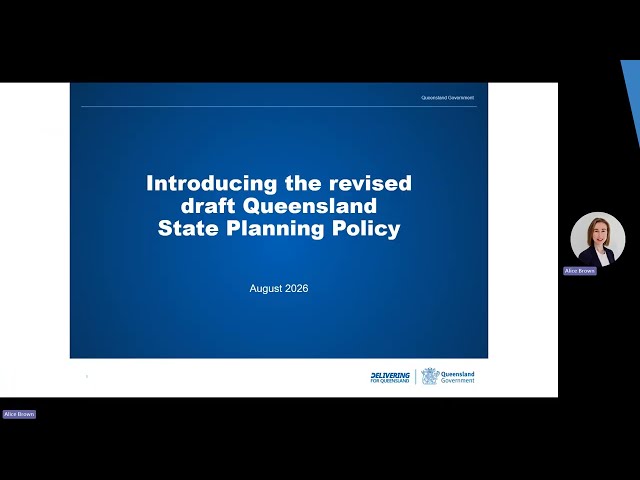
Supporting implementation materials will accompany the revised State Planning Policy to assist integration and consistent application. Some materials, including updated Minister’s Guidelines and Rules, are available as part of the consultation package, with additional resources such as further guidance and transitional arrangements to be developed and released as the draft State Planning Policy is progressed.
The sections below outline some of the key proposed changes in the draft State Planning Policy.
-
Strategic aspirations
One of the key changes proposed in the draft State Planning Policy is the introduction of six strategic aspirations that help describe the outcomes Queensland is working towards. These aspirations guide planning decisions, help balance competing state interests and support practical planning outcomes across Queensland. The state’s aspirations are:
- Build more housing and strong communities
- Promote efficient land use patterns
- Drive connected and productive regions
- Deliver responsive infrastructure
- Support existing economic drivers
- Attract emerging industries
State interests
The draft State Planning Policy retains many existing state interests while updating, consolidating or reorganising others to improve clarity and usability. A new Environment, Heritage and Efficient Growth state interest is proposed, while some related policy areas have been brought together under updated state interests to better align with the strategic aspirations and planning outcomes.
Key changes include:
- integration of housing-related policies into a strengthened Housing state interest
- new standalone state interests for Employment Land, Energy and Water to provide greater focus on these areas.
- introduction of the new Environment, Heritage and Efficient Growth state interest
- consolidation of revised biodiversity, coastal environment and cultural heritage policies into new and updated state interests
- consolidation of water quality policies into the Water state interest.
-
The draft State Planning Policy proposes a stronger focus on delivering housing to meet the needs of Queensland's growing population while ensuring communities are supported by the infrastructure, services and open spaces they need. The Housing state interest brings together policy direction relating to housing supply, urban design and strong communities.
Housing supply
The draft State Planning Policy proposes stronger direction to support a sufficient supply of serviced residential land in appropriate locations and ensure housing growth is coordinated with infrastructure planning. The intent is to support current and future housing needs while making efficient use of existing and planned infrastructure.
The draft framework also promotes a greater range of housing options, including a mix of dwelling types, lot sizes and housing tenures, to meet the needs of its growing communities.
To support more connected and well-planned communities, the draft State Planning Policy encourages higher-density housing and mixed-use development in and around centres and along transport corridors, with improved access to employment, services, public transport and community infrastructure.
Quality places and strong communities
The draft State Planning Policy proposes stronger policy direction relating to housing design, neighbourhood character and connected communities. The proposed policies promote:
- accessible and inclusive built environments
- neighbourhoods that reflect local character and community identity
- innovative and adaptable housing design
- places that are safe, connected and responsive to Queensland's weather
- access to open and green spaces that support recreation, wellbeing and Queensland’s lifestyle.
Housing is not only about the number of homes delivered. It is also about creating communities that are functional and built to meet long-term needs.
Well-located housing
The draft State Planning Policy encourages new housing to be located away from potential significant natural hazards and incompatible land uses where possible. This is intended to support safer and more affordable and resilient communities into the future.
Workforce housing
The draft State Planning Policy retains support for housing associated with approved large-scale mining, agriculture, industry and infrastructure projects, helping ensure suitable accommodation can be provided for non-resident workforces where required.
-
Queensland’s economy continues to evolve alongside population growth, changing industries and emerging technologies. The draft State Planning Policy proposes updates to better support employment, investment and long-term economic prosperity, while balancing economic outcomes with environmental, social and community considerations. The revised Economic Land state interest brings together policy direction relating to industry, employment, tourism, agriculture, resources and emerging economic opportunities.
Employment and industrial land
The draft State Planning Policy ensures an adequate supply of employment and industrial land is available to support current and future economic growth through:
- reducing infrastructure costs and duplication
- supporting orderly and logical development
- improving access for workers and businesses
- ensuring efficient use of land, infrastructure and services
- future-proofing development as it changes, intensifies and expands.
Employment and industrial areas play an important role in supporting business activity, investment and job creation. The proposed State Planning Policy seeks to protect these areas from incompatible development and support their ongoing operation and expansion where appropriate.
Emerging and future industries
Queensland’s planning framework must respond to changing economic opportunities and evolving industry needs. The draft State Planning Policy introduces a focus on industries that are expected to play an important role in Queensland’s future economy alongside continued support for existing and traditional industries.
The draft State Planning Policy supports new and emerging industries, such as defence, biofuels and biomedicine, and provides greater flexibility for economic development opportunities that contribute to Queensland's long-term prosperity.
Tourism
Tourism is and can be a more significant contributor to Queensland's economy and many regional communities. Supporting its growth is a key focus of the Queensland Government.
The draft State Planning Policy recognises the growing importance of Queensland’s dawn and night-time economies, including early morning, evening and late-night activities, services, hospitality and entertainment precincts. These contribute to economic growth, cultural life and community vitality across the state. The proposed approach supports these opportunities while considering community amenity and safety.
Queensland's coastal environment is one of the state's most important tourism assets. The draft State Planning Policy proposes to consolidate some previous coastal policy provisions within the Tourism state interest, reflecting the importance of protecting the coast, including the Great Barrier Reef, for current and future generations to use and enjoy.
This is about supporting the Queensland Government’s 20-year tourism plan, Destination 2045.
Agriculture
Queensland's agriculture sector plays an important role in supporting the state's economy, food security and regional communities. The overarching policy intent of supporting agriculture is unchanged, with a renewed focus on protecting and maintaining the long-term growth and productivity of agricultural industries.
The draft State Planning Policy brings existing agriculture-related policies together under a single state interest to improve clarity and support consistent implementation. It continues to:
- support the identification and protection of important agricultural land
- minimise land use conflicts and biosecurity risks
- safeguard the infrastructure, services and supply chains that support agricultural production.
The draft State Planning Policy also supports opportunities for complementary activities, including on-farm processing, farm gate sales and agricultural tourism.
This policy will help the Queensland Government reach its vision of increasing the value of primary production to $30 billion by 2030, and beyond.
Managing mining and extractive resources
Queensland's mineral, extractive and resource industries make a significant contribution to employment, regional economies and infrastructure development.
The draft State Planning Policy strengthens the support and long-term availability of important resource areas by protecting them from incompatible development and considering future resource access needs. The draft continues to support the identification and protection of Key Resource Areas, including associated processing areas, transport routes and separation areas.
The proposed approach aims to balance resource development opportunities with surrounding land uses and community interests.
-
Queensland's natural environment, heritage and natural resources play an important role in supporting communities, regional economies and the state's unique identity. The draft State Planning Policy proposes changes to improve the structure and clarity of the policy framework while maintaining protections for important environmental, heritage and natural resource values. The proposed policy framework seeks to support conservation by balancing environmental protection, economic development and community wellbeing.
Structure
The draft State Planning Policy proposes a revised structure that streamlines several existing state interests relating to the environment, heritage and natural resources. While the structure is proposed to change, the underlying policy intent remains largely unchanged. Existing policies have been consolidated and integrated into relevant new or updated state interests to improve clarity, reduce duplication and strengthen the connection between environmental protection, heritage considerations and growth planning.
Biodiversity
The draft State Planning Policy proposes to streamline biodiversity-related policies by integrating some provisions into the new Environment, Heritage and Efficient Growth state interest.
The proposed draft supports development and growth while protecting matters of environmental significance. This includes:
- identifying matters of environmental significance
- locating and designing development to avoid adverse impacts, including cumulative impacts, on matters of environmental significance
- mitigating adverse impacts where they cannot be avoided
- encouraging opportunities to restore and rehabilitate important environmental values
- supporting viable koala populations in South East Queensland by conserving koala habitat.
Coastal environment
The draft State Planning Policy continues to support growth and development that protects coastal processes, coastal resources and safe coastal use. This includes concentrating development within existing urban areas, avoiding the fragmentation of undeveloped coastal land and conserving the natural state and function of coastal landforms, wetlands and vegetation in erosion-prone areas.
The draft State Planning Policy also seeks to protect people and property from erosion, including coastal erosion, by avoiding inappropriate development in erosion-prone areas and maintaining safe and sustainable use of Queensland's coastal environment.
Protecting water quality
The draft State Planning Policy continues to support healthy catchments and the protection of Queensland's water quality by encouraging development to avoid or minimise impacts on waterways, wetlands, riparian vegetation, groundwater-dependent ecosystems and other important water resources.
The proposed State Planning Policy also supports safe and secure drinking water supplies for current and future generations by protecting water infrastructure, catchments and buffer areas, and by encouraging development that protects environmental values and contributes to the achievement of water quality objectives.
Heritage
Queensland's heritage contributes to the identity and character of places across the state. The draft State Planning Policy continues to support growth and development that recognises the importance of heritage significance by protecting and conserving places and areas of heritage.
The proposed State Planning Policy seeks to avoid adverse impacts on heritage places and matters of heritage significance, while supporting the conservation and adaptive reuse of state and local heritage places to help retain their cultural heritage values.
-
The draft State Planning Policy proposes a revised approach to natural hazards through the new Natural Hazards and Safety state interest. It will consolidate and streamline the previous Natural Hazards, Risk and Resilience state interest while retaining a focus on new development siting and design protecting people, property and infrastructure from potential natural hazards.
Natural hazards
The draft State Planning Policy seeks for new development to protect people and property from natural hazards by identifying natural hazard-prone areas and where development may be appropriate if an acceptable or tolerable level of risk can be achieved.
The proposed approach recognises that different hazards, developments and locations present different levels of risk. The level of planning regulation should be proportionate to the level of risk. Rather than the "avoid then mitigate" approach, the draft policy focuses on avoiding development where risks cannot be appropriately managed to an acceptable or tolerable level.
Development in natural hazard-prone areas should be appropriately located, designed and managed to reduce risks to people, property and infrastructure. The draft State Planning Policy also seeks to avoid increasing exposure to natural hazards and maintain or enhance the protective function of landscapes that help reduce natural hazard risks.
The draft policy recognises that natural hazard risk should be considered throughout the planning system, including regional planning, local plan-making, infrastructure planning and development assessment.
A consultation paper is also available on the state interest of natural hazards planning. It provides context for the review of these policies, shares early feedback and seeks detailed comments on proposed changes to the Natural Hazards and Resilience state interest.
Have your say and make a submission on the natural hazards planning policy discussion paper (
522.0 KB).Reliable infrastructure
Reliable infrastructure is essential to supporting communities before, during and after natural hazards. The draft policy promotes access to transport, energy, water, digital and essential community infrastructure by encouraging appropriate location, siting and design to avoid or mitigate exposure to natural hazard risks.
The proposed approach supports more reliable infrastructure and helps ensure planning decisions about growth, housing and infrastructure take natural hazard risk into account early in the planning process.
The draft State Planning Policy also supports the continued operation and efficient recovery of infrastructure following natural hazards, helping minimise disruptions to communities and essential services.
Erosion
The draft State Planning Policy continues to recognise the risks associated with erosion. The proposed approach seeks to avoid inappropriate new development in erosion-prone areas and support planning decisions that reduce risks to people and property.
The draft State Planning Policy also includes provisions relating to new development within coastal management districts, ensuring that development is appropriately located and designed where erosion risks are present and cannot reasonably be avoided.
Acid sulfate soils
Acid sulfate soils are naturally occurring soils that can impact waterways, infrastructure, the environment and human health when disturbed. The draft State Planning Policy continues to ensure new development supports protection of the natural and built environment, and human health, from the potential adverse impacts of acid sulfate soils.
The proposed approach includes identifying areas with a high risk of containing acid sulfate soils, avoiding or minimising disturbance where practicable, and appropriately managing impacts where disturbance cannot be avoided.
-
Queensland's growing population and changing communities need infrastructure and services that are planned, coordinated and delivered in the right locations at the right time. The draft State Planning Policy proposes updates to support more integrated planning for infrastructure, energy, water and transport networks, helping ensure communities can access essential services while supporting future growth.
The draft State Planning Policy also promotes development that is integrated with infrastructure and encourages growth in locations that can be efficiently serviced, helping support the needs of growing communities while maximising the benefits of infrastructure investment.
Social and community infrastructure
Social and community infrastructure plays an important role in supporting productive and functioning communities. The draft State Planning Policy includes social and community infrastructure to help ensure growing communities have access to the facilities and services they need.
The proposed policy seeks to:
- identify, protect and maintain land for social and community infrastructure by planning for current and future demand
- locate facilities in accessible and serviced areas
- support the co-location of complementary uses such as health and research precincts
- encourage infrastructure that is adaptable and designed for shared use.
Energy infrastructure
Reliable, affordable and sustainable energy is essential for communities, businesses and industries across Queensland. The draft State Planning Policy supports the development of energy infrastructure, including generation, storage, transmission and distribution networks, to help meet current and future needs and support connectivity and productivity across the state.
The proposed State Planning Policy seeks to protect existing and planned energy infrastructure and corridors from incompatible development, while supporting the safe and efficient delivery and operation of energy networks. It also includes measures to minimise impacts on communities, surrounding land uses and the natural and built environment.
Transport networks
Transport networks play an important role in connecting communities, supporting economic growth and enabling the efficient movement of people and goods across Queensland. The draft State Planning Policy continues to support the protection and operation of transport infrastructure, strategic airports, aviation facilities and ports, while encouraging development that supports the safe and efficient movement of people and goods across Queensland.
The proposed State Planning Policy includes measures to:
- protect existing and planned transport corridors, freight routes and intermodal terminals
- support development that is integrated with public and active transport networks
- encourage active transport networks that are safe, comfortable and connected to key destinations
- protect the safety and efficient operation of strategic airports, helicopter sites and ports
- support the ongoing growth of key transport, freight and logistics infrastructure.
-
The draft State Planning Policy proposes changes to how state interests are implemented to support a clearer and more streamlined planning framework.
Assessment benchmarks
The draft State Planning Policy proposes to move assessment benchmarks to the Planning Regulation 2017. Bringing state interest assessment benchmarks together in a single location will make them easier for assessment managers and applicants to access and apply, while allowing the State Planning Policy to focus on guiding regional planning and local government plan-making.
Assessment benchmarks are intended to be structured in a similar way to Schedule 12A Assessment benchmarks for particular reconfiguring a lot in the Planning Regulation 2017.
Read more about the proposed changes to assessment benchmarks (
516.5 KB).Minister's Guidelines and Rules
Updates to the Minister’s Guidelines and Rules will be made to align with the draft revised State Planning Policy and support its implementation through planning schemes.
Proposed changes include updating terminology to reflect the proposed revised state interests and ensuring strategic aspirations are considered as part of certain qualified state interest amendment processes. Additional changes will improve clarity and expand the minor amendment pathway for adopting state hazard mapping into planning schemes.
Read more about:
- proposed updated Minister’s Guidelines and Rules ( 13.6 MB)
- fact sheet about the changes ( 136.5 KB).
Transitional arrangements and implementation support
The Queensland Government is considering the most efficient pathways for local governments to implement the revised State Planning Policy, including transitional arrangements for planning scheme amendments that are already well advanced. Consideration is also being given to the interaction with regional plans and infrastructure plans, as well as the potential role of mandatory or model codes.
Guidance, training and other implementation support are proposed to assist local governments and industry during the transition.
- proposed updated Minister’s Guidelines and Rules (
Guidance material for the current State Planning Policy
Guidance material is available to help local government put the existing State Planning Policy into action.
-
- Integrating state interests in planning schemes – Guidance for local government
- Delivery of state interests through the Planning Regulation 2017 – Guidance for local government
- Strategic airports and aviation facilities state interest – Example planning scheme assessment benchmarks
- Natural hazards, risk and resilience state interest – Bushfire - Example planning scheme assessment benchmarks
- Natural hazards, risk and resilience – Bushfire: State Planning Policy – state interest guidance material
-
The SPP interactive mapping system (IMS) is available in a searchable spatial format.
In addition to the SPP IMS, further information about individual key resource areas is available:
- Mining and extractive resources state interest – Key Resource Area reports and maps 1 to 40 ( 23.1 MB)
- Mining and extractive resources state interest – Key Resource Area reports and maps 41 to 80 ( 27.4 MB)
- Mining and extractive resources state interest – Key Resource Area reports and maps 81 to 120 ( 22.5 MB)
- Mining and extractive resources state interest – Key Resource Area reports and maps 121 to 160 ( 23.4 MB)
- Mining and extractive resources state interest – Key Resource Area reports and maps 161 to 167 ( 6.1 MB)
- Mining and extractive resources state interest – Key Resource Area reports and maps 168 to 174 ( 5.8 MB)
For further information visit SPP Interactive Mapping System (IMS) - Schedule of amendments.
- Mining and extractive resources state interest – Key Resource Area reports and maps 1 to 40 (
-
- State Planning Policy - April 2016 ( 3.5 MB) - Commenced 29 April 2016. Repealed/lapsed 3 July 2017
- State Planning Policy - July 2014 ( 2.0 MB) - Commenced 1 July 2014. Repealed/lapsed 29 April 2016
- State Planning Policy - December 2013 ( 5.2 MB) - Commenced 2 December 2013. Repealed/lapsed 1 July 2014
- State Planning Policy - April 2016 (
More information
If you have any questions about the consultation or the State Planning Policy, contact planningforqueensland@dsdip.qld.gov.au
Information about the related review of State Assessment Referral Agency (SARA) triggers under the Planning Regulation 2017 is available.
Subscribe for planning updates from our department.
Last updated: 07 Sep 2026